When Exercise Becomes a Problem…

Trigger warning: Eating Disorders, Purging, Hospitals, Exercise.

NB: I will refer to myself as a fat person with negative connotations in this blog. This does not mean this belief that fat = bad relates to other people. The only human being I believe this of is myself.

*Takes a deep breath*

“My name is Ellie. And I am an addict”

Not something most people probably expect to hear from me. And my addiction isn’t what people default to thinking about when they think about addictions.

I’m addicted to exercise.

Most of you are probably reading that thinking “Big deal – don’t see the issue there”, “I could do with a bit of that exercise addiction”…and things along those lines.

Too much of anything is never a good thing. And that includes the holy grail of “things that are good for you”…physical activity.

Anyone who knows me knows that I’m an active person, I skate, I cycle, I do circus stuff, I like being outdoors etc. And thats totally true of me and who I am. Most people who know me will also know I have Anorexia. And these two things don’t always mix well.

I’ve always had a complicated relationship with exercise. As a child I did ballet and swam competitively. Ballet in particular has a reputation for being less-than-helpful for a child’s body image and the development of eating disorders. PE at school was horrific, I was shy and not good at any of the sports they did at school (the half-term of swimming lessons we got in Year 5 was my only time to not feel like a sedentary, worthless, fat blob). And all of this, paired with a complex relationship with netball and the politics that came with it at university – meant that for quite a while I avoided sports.

By the time I was an adult I had a full-blown eating disorder. And I have always displayed purging-type behaviours. My “go to” being self-induced vomiting but also other behaviours such as laxative abuse. However, over the years, exercise started becoming one of these behaviours.

Exercise saved my life, when things got very complex with my mental health – one of the ways out of the pit of darkness was re-discovering physical activity on my own terms – skating, circus skills, outdoor things. I am in no way saying exercise is bad, nor that it is bad for me in particular. But everything in moderation.

Over the years though, my attitude to exercise changed, even though I was doing activities because I genuinely enjoyed and was passionate about them, at the back of my mind was how many calories I was burning, and that it was something to keep my weight in check, that I needed people to know I wasn’t lazy, or that I needed people to know I was doing something about my fatness. Because exercise was so important in managing my mental health and well-being, I started to see this as one of my only ways of coping with difficult feelings. I was yearning after a toned-svelte body. Or more to the point, not to feel “fat”. Or more to the point, not to feel emotions. The girl in the mirror repulsed me, when I looked at my body I could see nothing but rolls of fat and bits that I hated. I was pushed forwards by my hatred of my own body.

The first time this became a proper issue was around 2018, when in a relapse of my eating disorder I became obsessed with skating as much as I possibly could. Although I came out of this relapse in terms of eating, I also came out of this relapse with a fairly high idea of what “normal” was for amount of exercise. But it was in check, I was doing stuff I loved and was sociable and fun, and I was fuelling my body properly. Things over the next couple of years perpetuated this dependence on high levels of physical activity – including another relapse of my eating disorder, an absence of anywhere safe to be during lockdown when the only reason to be outside was “partaking in exercise”, a loss of my driving licence which meant that my main form of transport was walking or cycling, and a huge part of my identity being “Ellie the roller skater”.

Fast forward to 2022. I’m in a really crappy life situation and had very little control over it. Perfect time for Anorexia to rear her head again. And she did this with all guns blazing. Combined with restriction of nutrition and fluids, purging and laxative abuse, my already high levels of exercise remained high – my body couldn’t handle all this and I ended up seriously physically unwell in hospital multiple times that year, coming close to dying at one point. My brain became more and more obsessed with burning calories – a starved brain will go back to its pre-historic ways of working which is to notice a lack of fuel and encourage us to move – as back in caveman days if we were hungry we needed to go hunting. In today’s modern day society that translates to excessive exercise and movement. In hospital after a near cardiac arrest, I was convinced I was off on a 4 hour bike ride the next day. My starved brain couldn’t understand why this physical activity wasn’t compatible with my body’s physical situation. Throughout this year I continued to exercise against medical advice. I honestly didn’t understand why it was a problem, exercise is good for you. I’m fat, need to lose weight, I’ll continue.

At the end of 2022 I was so physically unwell that I had no choice but to give up exercise. At that time in my life I could barely sit up for more than 10 minutes at a time. At the beginning of 2023 I began to get a little better physically and improved my intake and cut down other purging behaviours, I had some support from the eating disorder service but I was still banned from any physical activity and this was never fully addressed before I reached a “healthy” weight and was discharged from the service. Straight away I launched myself back into cycling everywhere, skating and other things that were a normal part of my life. Straight away I also started restricting. In July I started running. Every. Single. Morning. Rain or shine, injury or no injury, late night out or early night. I still ran. I have never really run before in my life. I was delighted that I went from hardly being able to run a few hundred metres to running non-stop for 30 minutes in a matter of weeks. I was finally getting fit and healthy! Maybe I’d no longer be a fat person.

Spurred on by my first park run (sub 30 minutes, 2 months after taking up running), and positive feedback from the world around me “you’re so dedicated”, “you’re so determined”. I continued. I got worried about the winter and that I would get fatter as it got darker and colder so I joined the gym. The person doing the induction commented on my ability to hold a plank “forever and a day” and my visible shoulder muscles when trying out the weight machines. This spurred me on even more. People seemed to be perceiving me as a fit person not a fat person. Gosh. They must be half-blind, I’m just a fat, lazy person masquerading as a fit person – I’d better do more to prove myself. I. Could. Not. Stop.

As my exercise increased, my intake decreased. I had been subsisting mostly on fruit and vegetables for several months – but eating in front of people from time to time when going out for a meal. Everyone thought I was doing well with food. Nice to see you out and about. Great to see you doing the physical activity you love. I. Could. Not. Stop. It would be letting others down.

But I wasn’t loving it. I would be wishing that someone would stop me. Physically hold me down and stop me having to go out and run in the rain. I would be crying in the gym. Constantly aching and feeling horrific. I turned down more and more social events. If it wasn’t physical activity orientated then I wasn’t going. Then slowly this balance tipped even more. Even my previously loved active hobbies like skating and circus were replaced by running, cross trainer and random gym classes. I managed to keep doing things like yoga – but even this I would be doing an excessive amount of times a week on top of everything else. Each week I had to do more than last week, to prove I wasn’t lazy. I. Could. Not. Stop.

I perceived nothing wrong with what I was doing. The reason I hated it was because I was still too fat and lazy. I would find any excuse as to why I needed to do my exercise. Things started happening that were quite scary. Collapsing after park run. Finding myself on a dark country road in the rain, no bike lights, muscles not responding and brain hallucinating police cars going past again and again. Spraining my ankle after a morning of being bullied by my eating disorder to run from class to class. Cross trainer, run to yoga studio, hot pilates class, run to gym, weights, yoga class, run, run back to gym, dance fitness class…I carried on going despite having fallen, sprained my ankle and spent 10 minutes crying on the floor in the woods because I was worried I wouldn’t get my exercise hours in that day. I. Could. Not. Stop.

The recommended weekly physical activity levels became my daily minimum. Hours in the gym before work, followed by more activity after. If I was working from home then I would pop across to the gym in gaps in my day. If I was working from the office it was chance to get an extra cycle in. But I still had to sit down to do my job. I was genuinely considering giving up the job I loved in order to do one that was more physically active. I. Could. Not. Stop.

I referred myself to the Eating Disorders charity. They took me on straight away. The care was so Ellie-centred, so trauma-informed, so much more than I was expecting or thought I deserved. But the exercise is a problem. People are telling me its dangerous, I’m at risk. I have a history of a dangerously low heart rate and other cardiac issues and these could happen again. But I don’t understand. I’m not on death’s door like I was a while back. I understand I do a lot of movement – but I have my reasons for it. My intake was increased and my exercise just increased with it. I’m sitting in meetings with professionals who know me well, who I trust and respect. They’re all on the same page, telling me this is a problem. My eating disorder doesn’t have anywhere to hide and I squirm throughout the meeting with nowhere to escape to. But something in my mind makes me feel like I must be pulling the wool over their eyes in some way. Can’t they see I’m fat and lazy. I. Can’t. Stop.

The last few paragraphs are all things that have happened in the past few weeks. I’m still in the middle of it. My whole life is exercise. Last week I counted 27 hours of exercise – and I definitely didn’t include everything. I. Can’t. Stop. I want nothing more than to recover from my eating disorder. And I’m almost happy to be told I need to eat more. But I can’t stop exercising. I can’t imagine how I would function without it, what I’d do with my time, how I’d manage my mental health, how my body would balloon in size, how my body image would just get worse. People probably think I’m being less active because I am not turning up to the skatepark, to work, to acro practice – but in reality I’m stuck doing things that burns calories more intensely. I hate having to spend hours on the cross trainer because thats what my eating disorder tells me to do. I will turn down a skating session with friends in order to do that. I hate having abandoned all my friendships and social life. I hate that I only wear sports clothes and that it took me 4 months to dye my hair and even when I did it I had to go to the gym to work out with bleached hair before I had time to dye it properly. But I hate my body even more than all of these things. And thats what keeps this going. I. Can’t. Stop.

I have read a bit more recently on exercise addiction. And I do see everything in myself in the writing and the criteria. I do understand I have a problem. But I don’t know how to solve it. I’ll take a little advice from exercise professionals – but many don’t notice the problem. But I struggle to take on board what everyone else is telling me.

Exercising a lot is only ever perceived as a good thing. Society encourages us to do more – chastises those that don’t move enough and putting those that push their bodies to the physical limits on some sort of super human pedestal. The feedback I get from people I come across in my day to day life who don’t know the extent of the problem just give me more encouragement to keep moving. Recovering from a restrictive eating disorder is hard enough when society is full of diet culture and you have to go against the grain of what your head is telling you and what society is telling you, but most people can conceptualise that an anorexic needs to eat more. The general population struggle to conceptualise that its possible to be too active, and my brain does too.

I don’t know what happens next. And I’m not writing this blog with any words of wisdom of how to help someone who is addicted to exercise, or putting themselves in danger because of it. I’m also not writing it asking for advice. I think I’m writing it to raise awareness. Ultimately the change needs to come from within me, but I’m not sure I’m there yet. I don’t want to throw away this opportunity I have of excellent eating disorder support which is right for me. I also don’t want to throw away my life and the good stuff that could happen. I have genuine things I would like to do in life and some of these involve physical fitness – do a sprint triathlon, more trekking and bike packing. But anorexia is so strong, so all consuming – the thought of fighting my way out terrifies me. I’ve been in some dark and dangerous places with my eating disorder in the past and this doesn’t feel like one of them, although I’m told it is and also that my “baseline” for “I’m fine’ is spectacularly low compared to most people. It feels like a horrific thought to have to fight my way out again. But I know if I carry on it will only be harder to get out.

I don’t often write my blog posts in the moment of something being an issue. Most are retrospective when I have had chance to process the subject matter. But I felt that I maybe needed to blog at this point to show how confusing eating disorders can be for the sufferer. We have so many conflicting internal ideas of right and wrong. So I apologise for the raw and rambly nature of this one. But I hope it educates and gets people thinking.
Burn Survivor Weekend

TW: Self-harm, suicide, mental health crisis, psychiatric ward, burns, fire. This is a graphic post.

So it isn’t a secret that I am burned. It also isn’t a secret that part of my C-PTSD is centred around fire. And I’ve struggled for 8 years with the consequences of this. But its only this year, 2023 that I have accessed burns-specific support.

So why has it taken me so long?

The short answer is shame. The long answer I don’t think is possible to verbalise. But I came a huge step closer to that this weekend.

My burns were self-inflicted. At very low points in my life I have used fire – or other things that burn – to hurt myself. I didn’t need much help to feel incredibly guilty about this. But I (unfortunately) was helped along a lot by a rhetoric around me at the time that it was my fault I couldn’t control my “impulses” (my self harm is not impulsive, its compulsive – but thats another story) or my emotions. Why on earth then would I ever, ever think that I had the right to access support from the burns community – where so many people had no choice in what happened to them. When I effectively “chose” to be burned.

Although I speak openly about my mental health in a variety of context including education of staff, I tend to gloss over the “I set myself on fire” thing. Even in terms of living day to day with my PTSD I don’t easily volunteer that information – and although I may tell people that is connected to my PTSD – I don’t bring the actual event up that much. I struggle so much with dissociation and flashbacks thats its difficult for me to actively choose to think about it, let alone tell my story.

In 2015, whilst an inpatient in a psychiatric ward. I set myself on fire. I suffered from third degree burns on my torso and leg, and lesser-degree burns on my arms and hands. I also began to suffer with what was to become debilitating PTSD related to the event. 2 days after the fact, I was discharged to the community with little to no mental health support and set fire to my leg outside A&E a few weeks later.

A combination of me being unwilling to accept what had happened, unwilling to engage and a lack of support available or offered to me, meant that although I received the physical care I needed for my burns in 2015, I did not receive any of the psychological support I needed. I spent over 4 months in bandages followed by a year in pressure garments (a vest and a leg sleeve) before I disengaged with this too. I think also there is a presumption that if you have done it to yourself – it won’t affect you psychologically in the same way.

That is so wrong. For 8 years I have been actively disabled by my PTSD. I now know (though only from work done in the past year in therapy), that my trauma around fire and the feelings that came from the experience of being on fire – goes way back before November 14th 2015. In actual fact – its not that surprising – understanding what I do now – that fire was my weapon of choice. But still, despite starting to understand this my shame and guilt continued.

In April this year, following a series of events (including a Doctor refusing to suture my face because (in his words) “you have plenty of scars, one more doesn’t matter”. I finally gave in to the compulsion I had had since 2018 to create a burn on my face. I have had a long history of harming my face – also stemming from some specific trauma. I did not stop until that exact compulsion, and image I had had in my mind and tried to push away for so long, was complete. And this involved repeat incidents – in total I burnt my face using strong alkaline chemicals 7 times before seeking medical treatment. Burn upon burn upon burn until I knew I was done. When I had finished I had a 3rd degree burn the size of my hand on the side of my face. The right hand side of my entire head swelled to twice the size. I was admitted to hospital. We didn’t know if I might have lost some of the vision in my eye. I already hated my face – I’ve been actively hurting it and trying to make it unattractive to unwanted male attention for years. Now I was unrecognisable.

Swelling dies down. But serious burns don’t just go away. After nearly 6 weeks with a big, black patch of dead and burnt skin on my face, I finally made the decision to accept a skin graft. Medically it was a totally obvious decision. Psychologically, not so. Why would I do this thing that might make my hated face look better? Why would I do something that was looking after my face? I was already struggling with the care I needed to give my burns. Having healing (or not healing as was the case) burns is a full time job and even bathing it reduced me to tears every time and I struggled to do the facial exercises set for me by my OT. To make the decision to have the graft I did a lot of soul searching, I spoke to many people I know and professionals in my physical and mental health care, I looked deep inside myself. I really appreciated the friends that supported me through this time with dark humour. “Ellie’s dead face” became an entity in its own right. I knew, that making this decision would make or break where I went next. And eventually I took the plunge and on 9th May 2023 I had a full thickness skin graft – replacing the dead (and by now pretty stinky) face with skin from my right thigh.

I struggled with the surgery and the aftermath. The thought of someone having touched my face and had control over what it was going to look like terrified me. Part of me was worried it would look horrific and part of me was worried that it would look like a perfect face again. I don’t know which scared me more. Dressing changes were traumatic – I dissociate as soon as anyone touches my face and can become very distressed and volatile. But we managed it, with careful care from the burns nurses and my wonderful carer, Shami. I broke down before the first time I had to look in the mirror. But as soon as I did, something inside of me let me know I’d made the right decision – to care for myself by accepting the graft.

And this was the start of considering moving forwards. In a roundabout way I had to get burnt twice to start to heal.

Over the next couple of months I opened up more about fire in therapy. Signposted by the burns unit I first received some support from Changing Faces https://www.changingfaces.org.uk/ which I found really helpful, before eventually taking the plunge and joining an online support group for burns survivors. This was a massive step as I hadn’t accessed any support before in 8 years. But I still felt like I shouldn’t be there.

So I felt even less like I should be an attendee at Dan’s Fund For Burns (DFFB) Adult Burn Survivors weekend. https://dansfundforburns.org/ I made the decision to go but in my head I was going to back out. I couldn’t go. It was a place for real burns survivors, not people who had done it to themselves like me. How could I possibly have the audacity to be there when other people hadn’t had a choice in being burnt?

Even when I arrived, at a beautiful hotel in the Surrey hills, I was panicking. my anxiety was sky high. The first evening I was plagued with thoughts convinced everyone would be saying “she shouldn’t be here – she did it to herself, she doesn’t deserve to be here”. Even though everyone was lovely, I worked myself up to convince myself that when everyone found out the truth I would be thrown out and rejected. For the record – everyone was actually lovely and these are all my projected thoughts and fears! However, despite the lovely evening and brilliant pub quiz, I found myself dissociating quite a bit and struggling to stay grounded. My traumatised mind did not want me to be there. Although I really appreciated that everyone was talking openly about scarring and burns, I struggled to tell many why I had burns.

The Saturday morning started off (after a beautiful outdoor yoga session), with a talk from Polly, the founder of DFFB. She had been in the Bali bombings, where she had lost her husband, Dan, along with several friends. she subsequently set up the charity in Dan’s name that has raised over £2.9 Million in 20 years and provides burns support, befriending, financial support and more to people across the country.

After this, the programme said “Open Mic”. I wasn’t 100% sure what this meant, but it turned out to be an opportunity for people to share their stories.

And this is when the magic really began.

I am used to the mental health world. Where confidentiality means you have no clue what is happening for anyone else. Self harm, scars, stories of events, triggering topics and trauma are taboo. Judgement is rife (from service users and staff) and often people are oddly competing to story top or “be the illest”. Everything is incredibly censored. I became acutely aware this weekend that even when I am sharing my mental health story to educate – I censor it heavily for the sake of other people.

This was the exact opposite. People stood up with the microphone (or without, or sat down, or stood at the back – whatever worked for them), and spoke, honestly about their stories. Their injury, what happened, how they were burnt, how much they were burnt, the recovery process, trauma, people they’d lost, things they’d gained.

Even 3 months ago I would have not have been able to sit in that room. I have such a low tolerance for experiencing or even hearing about triggers without dissociating that I would just have not been able to be there. Or if I had I wouldn’t have heard what was being said as my brain tried to protect me.

But I heard every word. The room listened raptly to every individual who stood up there. Every member of the audience with that person on every step of their recounted journey.

And the stories, the stories were painful. They were raw. They were tragic. They were sad. They were uplifting. They were joyful. They were hopeful. They were humorous. Every single emotion a human being could possibly feel must have been felt in that 2 hour session. They were resilient. They were courageous. They were vulnerable. It was an absolutely privilege to be in that space. I won’t recount other people’s stories -they’re not mine to tell, it was a safe space for those that got it. It was an absolute honour to hear them.

Everyone had scars. And it didn’t matter if they were big or small. Visible or hidden. Whether the story was an international headline or a home accident gone unnoticed by the rest of the world. Everyone in that room had experienced their life changing forever. And the experience of continuing living in the aftermath of that event.

I’ve never met another person who knows what its like to be in on fire. Not like “shit I accidentally caught my hair and blew it out” on fire but engulfed in flames sort of on fire. That experience and the feelings that came with it are what plague and disable me every single day. And here I was in a room which was full of people who knew what that felt like (Disclaimer: this wasn’t everybody – there are plenty of other ways to obtain burn injuries – but there were a fair few). And just knowing that was healing it itself. I wasn’t alone in that experience.

I wasn’t going to speak. I didn’t think I could. It didn’t seem fair after hearing all those journeys. But there was a gap – and I somehow found myself at the front of the room. I honestly can’t remember what I said. Except I explained at the start that it was literally my job to talk about lived experience of mental health. But not my burns story, and I didn’t think I could do it. I took a deep breath and admitted to the room that unlike a lot of them, I had a choice in my injury. That in 2015, at a point in my life where I didn’t think I could get any lower, I took a lighter to my hospital night gown and set myself on fire in a psychiatric unit. I don’t really remember much else of what I said. Except that I got emotional. I am never emotional when talking about my story. I am entirely disconnected. I rambled on in what felt like a really incoherent babble before losing my way and returning to break down in tears in Shami’s arms. I’d for sure just turned a room of human beings on me – they must hate me now for what I’d done.

But then the lady in front of me turned around and squeezed my hand. The guy next to me said well done and thank you. From behind me a woman hugged my shoulders. Polly took the mic and said to the room that we all had a right to be there and deserved support.

Even me. The girl who set herself on fire.

The session continued with people telling their stories. The guy next to me got up and went to the front. He looked straight at me and said “I wasn’t going to come up. But then Ellie did, and I felt that I could too – because I too feel responsible for my burns”. His story was different to mine but he had the same feelings of shame, guilt and unreservedness because he felt it was self inflicted. After he finished speaking and returned to his seat we both told each other we were proud and shared a hug.

And in that 2 hours, everything changed. That anxiety and separateness and paranoia I had felt melted away. Straight after, and for the rest of the weekend people showed their support, and appreciation that what I did was brave. People asked more about self harm and how it worked. Another person came up and said she felt her injuries were self inflicted in a way too. One woman took me through her emotional journey as she listened to me speak – first anger towards me, then anger towards others, then empathy and finally pride. Everyone reiterated that I had as much right to be there as everyone else.

The rest of the weekend flew by. With more story sharing. Talking about scars and laughing about situations we’d been in because of them. Dark humour was rife which is my favourite way of coping with difficult stuff. There was an amazing dinner and dancing – people boogying away like no-one was watching. Because for once, no one was watching. Most of us were used to being stared at in some way because we look different. We were used to being the elephants in the room but now we were a whole herd of elephants. I wondered what the few other people at the hotel thought – being in the minority as they were not scarred.

Several more challenges presented themselves over the weekend. But unlike normal, I was able to face them head on. This weekend – where I had expected to be a dissociated, triggered mess, I was actually more grounded and in the present than I have ever been.

An amazing bunch of ladies were volunteering their time that weekend to give free scar massage. Burnt skin is very thick and tight, often in contracts causing mobility issues, pain and even limb loss. Part of scar management is massaging to help break down the scar tissue. its a different kind of massage than those you might get at a beauty place. Its something I find very hard and I think is something a lot of us are not great at doing for ourselves.

I don’t look at or touch or do anything with the scars on my torso. I’m fairly lucky as they are mainly on my ribcage they don’t cause me any mobility issues. I definitely don’t let others see or touch them. So I also didn’t expect to actually go through with my scar massage session. However Claire, the therapist who was working with me understood my fears and really put me at ease. It felt so alien, to let another person spend an hour caring for a part of my body that I resent so much for what it symbolises. But it actually felt really nice. Afterwards my scars were much paler and flatter, and to my surprise I found that I could breathe easier – I think my scar (which has contracted a lot) has actually been stopping my ribcage from fully expanding without me realising.

Anyone who knows me even a little bit knows I go to massive lengths (to the extent of being in danger or ending up homeless) to avoid triggers. But this weekend showed me that I can, somewhere deep down, do the things I avoid doing. And I did one of those this weekend.

I was sat on Saturday night between two women, chatting to one of them and we were about to retire for the night. She held a lighter out and asked me to pass it to the woman on the other side. “I can’t touch lighters” I said.

“Of course, thats fine” She replied. And went to reach further so she could pass it herself. She didn’t question my inability. she just understood.

I stopped her. No I can do this. I took the lighter and passed it to the next woman.

Everyone who knows me also knows that I go mute if I’m even slightly triggered. But after passing the lighter. I turned and said “The last lighter I touched was the one I used to set myself alight.” Not only had I touched another lighter, but I had words to explain the hugeness of what I’d done. She embraced me in the biggest hug.

I skipped all the way to my bedroom. 5 minutes after having held a lighter in my hand.

Now I’m not expecting that tomorrow I’m going to be grabbing lighters left right and centre. Nor am I going to be enjoying candle-lit baths, bonfire night, cooking myself something on the hob or shutting myself in a room by myself. But that night I proved to myself that I can do those things.

I have been stuck for 8 years. Trapped by my own fire. This weekend unstuck me. It oiled my gears just enough so that they could inch forward and I could see that there is a stage ahead. Something I didn’t know was there. But at this weekend there were people who had gone through that stage and moved forwards. There were people still on that journey. But most importantly it proved to me that it is possible. Even the most stuck people can move forward. Time heals too.

I’m so grateful to have had this opportunity. To feel empowered. To have hope. To feel like maybe I do have more control over my life than I thought. I will move forwards, and it will take time, and I will still need some help. But I will move forwards.

The next chapter is just beginning.

Feel the fear…and do it anyway?

All my life I’ve been running… running away from what? My past? My trauma? I’m not even always so sure. For the last 20 years at least, I’ve been running blindly, never looking back.

In whatever way you could run from life I’ve done it. I’ve moved abroad multiple times. I’ve travelled. I’ve kept myself insanely busy (during my final year of uni I did a full-time degree with placements, supply taught, volunteered in a school, ran a rainbow, brownie, guide and senior section group, had a weekend job at a milkshake shop, was president of the uni netball team, played in a local netball team, lead a Girlguiding UK development project to Chile and organised the project and the team members throughout the year of preparation, I fundraised for said trip, I never spent a holiday or week off in the UK, I went out up to 4 nights a week…and that was potentially one of the calmer times in my life). I’ve had more suicide attempts than I can count, and probably at this point a thousand or more episodes of self harm. I’ve drank into oblivion. The one method of running away I haven’t really used is hard drugs – once was enough for me – it didn’t end well. I have physically ran away, and still do – whether consciously or not. I have disappeared. I have starved myself. I have got myself sectioned and locked up or sent away so I was still effectively running from life. I’ve filled my days with exercise – adrenaline-ridden sports. I dissociate – much more than most people appreciate – I don’t feel a lot of feelings because dissociation protects me. I’ve never, ever in my adult life stopped running.

But for the first time I’ve started to look over my shoulder at what I’m running away from.

And I feel fear.

And its fucking awful.

I’m 6/7 months into my first proper attempt at therapy. I’ve had some partial therapy situations before but either its been the wrong therapy, the wrong time, I’ve not really engaged or it was just too short and shallow. I’ve never really had the chance to look back.

For the first time in probably at least 8 years my life is fairly stable (in my terms anyway – I have a stable roof over my head, a job, my body is not about to pack in physically and no active trauma is happening to me). But yet every single day is still riddled with fear. My body courses with adrenaline that I can’t keep in check. Last week things really came to a head and I ended up getting really distressed because of this fear. I couldn’t function, caused a scene at work, and the skatepark and various other places. Things weren’t OK. I cope pretty well when things are shitty around me – Its my normal. I found myself yearning after 2020 when I had no safe place to stay, was exhausted, life was terrible and unsafe and i wouldn’t wish it on my worst enemy, but some how made it through – why couldn’t I be the person I was then? Why can’t I make it through my safe cushy day today – where I have a roof over my head, no immediate danger?

So I was struggling to function last week when I rang up the duty team to speak to someone. I was so scared something horrific was going to happen. I’ve lived my life with bad things happening to me – why would now be suddenly different? I told the person on the end of the phone (“oh I haven’t had chance to read your notes but I know your care co-ordinator is x”) – “I’m feeling fear, I’m feeling so scared. I’m terrified”

So you can imagine it went down really well when they suggested “have you tried mindful colouring?”

In my mind I’m literally doing the equivalent of running from a bear – and you suggest stopping and doing some colouring? – no wonder crisis care is in a mess.

Cause of distress = fear

Solution – colouring in

It doesn’t make sense? I rang on 2 separate days – had varied experiences but none of them made me feel much better – phone calls of over 30 minutes just served me feeling less understood and more anxious…and questioning where I had put my colouring pens…

After several days of feeling like everything bad that had ever happened in the world was probably about to happen to me (and my mood and ability of socialise and function reflecting this was not great). I rang the charity who provide me with therapy. I didn’t speak to my therapist – she only works 2 days a week, but spoke to her supervisor – the clinical director. I only spoke to her for about 12 minutes. But she didn’t suggest colouring in. She explained to me what was happening.

She was describing it to me as a smoke alarm going off – but its just someone burning the toast. My smoke alarm is in excellent working order – but its going off all the time – because in the past its had to. I have been in so many situations in my life where fear was the appropriate response (whether or not I actually felt that at the time is another issue) that my smoke alarm’s default setting is kind of set to “going off”. Imagine you hear a car alarm on the street – and you get filled with fear-based adrenaline. It must be your car that is being stolen! You check out of your window and your car is there, safe and sound and the alarm is coming from further down the street. In theory you can rest, safe in the knowledge its not your car that is sounding the alarm. But you don’t rest. The constant siren puts you on edge, you can’t concentrate, you can’t watch TV, you can’t get anything done. In the end you get up and leave the house – do something to keep you occupied and away from the noise.

That is what my life is like, living with Complex PTSD every single day. My smoke alarm. Or my car alarm, is going off all the time.

But this was so much more useful information than “why not try some colouring”. No it didn’t solve the problem or provide me with a solution to make it go away. But it explained to me why I was feeling the way I did. And more to the point – instead of suggesting distracting and not having the feelings at all like I’ve always been told to do – the suggestion was feel it.

Now the idea of feeling fear, and sitting with it, invokes even more fear within me. This isn’t going to be an easy ride. And I’m angry that I have to do it because of things other people have done to invoke fear in me in the past.

My therapist yesterday explained that all of this fear feeling is a good thing. I’m not using dissociation to blank everything out. It means that doing therapy is useful for me. But it doesn’t mean its easy. She likened it to climbing a mountain – its never straight up and there are ups and downs and obstacles. At the moment I’ve kind of gone down into a bog – its in a bit of a dip and I can’t really see out of where I am now, and I’m making massive efforts to take steps forwards but I’m not moving anywhere. But I’m still taking those steps. I could stop and go back – but I’d still be on a mountain. Or I can carry on, eventually I’ll be out of a bog and have a bit of a better view of the path just travelled and the road ahead. But for now I’m just stuck trudging through the bog. With a bear chasing me.

Nice.

Needs Must – why paying attention to the hierarchy of needs is important in helping mental health service users to achieve their full potential

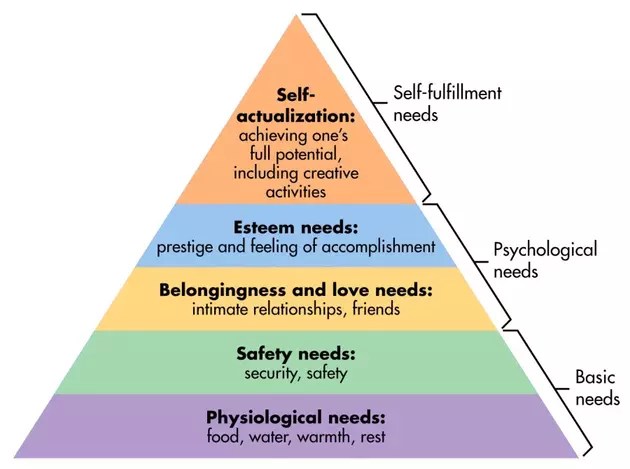
Most people are at least vaguely familiar with this diagram – Maslow’s Hierarchy of Needs. The theory being that we need the lower layers to be stable and consistent to build on the ones above.

My basic needs being met is something I’ve battled with consistently for at least the last half decade – in reality I’ve probably struggled to have my needs met for most of my life but because I had my basic needs covered – the rest of the pyramid appeared to be relatively stable, from the outside at least.

For the past couple of years I’ve struggled getting the lower 4 sections of my needs met. I can function to some extent if my basic needs are met – even if some of the higher ones, particularly psychological needs, are not met. However when those basic needs that everyone take for granted start to slide, things unravel pretty fast.

I’m at another point in my life where yet again my base layer of needs – Physiological needs – are not being met. And not surprisingly everything has fallen down around me. I’ve worked hard over the years to build the upper layers for myself – building friendships, working, doing things that bring me joy and boost my esteem – but the foundation layers have always been wobbly, so it doesn’t take much to bring them tumbling down.

Because I’m eloquent, generally fairly well dressed, have a job (even if I’m not working at the moment) and seem to have insight into my mental health problems, I often find that when people are taking my psychiatric history they skip out the more social aspects such as housing, safety and financial situation – all of which are major problems for me – but are presumed to be sorted because of the aforementioned eloquence. It’s the same equivalent as getting a really depressed person in and not asking them about elevated mood because they look so low right now. It’s really important to cover every area because you don’t know what might be lurking in people’s corners.

Currently, as a direct result of my mental health problems, I am not able to meet my basic physiological needs consistently – food (I can’t always afford it and I can’t heat things up myself so left without help I can only have cold food), shelter (I cannot access my house – even step beyond the threshold without support – renting a house is not the same as being able to access a house – and because my situation is so dire currently I don’t have any access to my house during the day times and don’t have access to my house 7 nights a week), warmth (comes along with the previous two – I’m stuck outside left to my own devices), rest (impossible when you don’t have somewhere to shelter and put your head down or even just chill out), water (I don’t have access to a toilet without walking at least 15 minutes (if places are open) or somewhere to wash except my cold outdoor tap).

Because my basic needs are not met, the next layer of needs – safety needs are difficult to meet. If I am unable to access my house, especially at night I am putting myself and my belongings at risk by sleeping rough, in my garden, being out and about at inappropriate times of night or being out and about in the day when its wet, or I am simply tired and don’t want to be out but have to be anyway. Add that to the fact that I’m in a significant mental health crisis right now – my security and safety are once again very compromised. Because of my PTSD I would not be able to protect myself from an intruder or attack as I go mute and freeze and/or dissociate very easily.

The next layer of needs are a complex one – the psychological needs. Some of these I am actually really good at doing myself (if the needs underneath are met adequately to support this). Belongingness and love needs – I make and sustain friendships very easily – however, at times when my other needs are not met – my friends are often relied upon by services to be my mental health carers and this is very damaging. However, because of untreated trauma, I have never (at the ripe age of 34) been in a romantic relationship. And I don’t think I ever will be able to unless I’m given the opportunity to address my trauma.

The next level, esteem needs is another complicated one. I have worked hard over the years to do things that increase my self-esteem as its naturally very low and because of being in repeated traumatic situations like this one it gets knocked down very easily. Prestige and a feeling of accomplishment is a very personal thing – sometimes I feel proud because I’ve slept rough and actually been independent for the night instead of having to rely on someone else – even if the experience was horrible. Other people might get a lot of feelings pf prestige over work promotions or buying a really fancy car, having children or owning a home. I get a lot of feelings of accomplishment through my skating and also through my work. But at the moment both of these thing are difficult to do because, quite frankly its impossible to turn up to the office and not be a total wreck when you’ve got the anxiety of a night with no shelter ahead of you. So once again this higher tier can’t be achieved unless the base layers underneath are adequate.

The top tier – self-actualisation, is something I definitely have not managed to achieve by any means in the lat decade. Achieving one’s full potential. I’m not denying that I haven’t made progress in some areas – less self-harm, more work and positive activities. But I’m hugely held back on this one because once again, nothing in the upper tiers is achievable if you don’t have the lower tiers nice and stable. I will never be able to move forward professionally – because I’m unreliable at work, because my basic and psychological needs aren’t met. I do have the potential, I know I do – I’m hard-working, fairly intelligent and good at making connections – but I will never be able to achieve my potential without the bottom 4 layers being dealt with.

I get a lot of people saying to me “oh but you have a job, you have so many friends, you have super fun hobbies – everything must be fine!” – but these mean very little, and in themselves are not achievable or sustainable if you don’t have a roof over your head and warm food in your belly. Everyone sympathises with the whole “moving house or separating is one of the most stressful things a human can do” thing – because in that process all our basic and psychological needs are jeopardised – even if that’s just for one day. Imagine if every day was as stressful as moving day, or the day you finally got a divorce. Thats what it is like for many of us with complex mental health problems who struggle to meet our basic needs every day. Whether that’s someone with memory issues who forgets to feed themselves or leaves the back door open by mistake. The person with depression who pushes away all their friends and family. The person with bi-polar who burns out because they haven’t slept for days on end. We’re all struggling to get those basic things seen to – so don’t be surprised when we can’t hold down a job, struggle to make friends or join a knitting group.

Work from the bottom upwards, slowly and steadily and you can help someone build a solid foundation upon which they can really achieve their full potential.

A Different Kind Of Crisis Care

April is a bit of a blur for me. I have not been well at all (and had been ignoring warning signs beforehand) but it finally got to the point where even I had to admit I was unwell. It was a bit of a perfect storm in terms of precipitating factors (which I don’t want to go into here but came from several areas of life and were largely out of my control), to be honest some of those things on their own would be enough to knock any bird off it’s perch – but a lot came at once and because I had been ignoring other warning signs beforehand (which was under my control but I’m having a hard time learning to cut myself slack and not try and paint a mask on) and it all kind of came to a head.

I carried on attempting to persevere – turning up to work, pretending things were OK etc. But by that point my body and my mind had already gone through the mill a bit and it wasn’t until I got to the point I was unable to remember being in various meetings at work, unable to travel from A to B independently, and even not be able to do the washing up, tolerate having my beloved ratty boys around me or remember to eat or drink, That I finally started listening to those around me and admitted I might need to take it easy for a while and look after my mental wellbeing. I am someone who lives with severe mental health problems every day but goes to great lengths to live a life of someone who doesn’t…and inevitably I can’t keep it up forever.

It’s been a long, hard slog – and one that felt like it was only going from bad to worse for a good few weeks. But I’m finally starting to piece myself back together – but tentatively. This has been a period of significant crisis – of which I probably haven’t had now for about 6 months since my life became a lot more stable and manageable. However, for the first time, we navigated through this crisis using the resources that were already available to me – but just more flexibly. I did not need intervention from the crisis team or home treatment, nor did I need to spend the night in the decisions unit, crisis house or a ward – and this is new to me but so much better. Yes, I did need medical attention on several occasions and the emergency services were also involved several times but these were all well dealt with and swiftly able to be handed over back to my normal care.

As well as being mentally unwell I have also struggled with the after effects of several head injuries which has resulted in an elongated period of concussion making me physically less able, struggling with memory, processing and managing tasks etc. This has been something I’ve found particularly difficult as I couldn’t do the things that help myself. Hats off to those that live and manage life with a more serious long-term brain injury. It really is hard.

So what helped manage this crisis period? I have several things at my disposal now that I have not always had in the past – or have had these things limited and therefore my ability to utilise them wasn’t great.

A safe place: This is the first time in a number of years that I’ve gone into a crisis and had a safe place in which to attempt to heal myself. A stable, accessible and safe home has not been a given for me until very recently. In the past year I’ve had the physical safe place but not always the means to access it. This time, I was able to use my support hours flexibly so my awesome team of Personal Assistants (PAs) could help me stay at home as much as I needed. This is so basic and something a lot of other people don’t even think about but for me has been something I’ve never had. It’s the absolute baseline of maslow’s hierarchy of needs and without this there is little point trying anything else. It makes me cringe when I’ve been in crisis previously and been sent back out into the cold with no safe place to be – told to “use my coping skills” and maybe offered a follow up phone call – how could anyone ever think I could successfully pull through a crisis without that? I spent years beating myself up because I couldn’t – but now I’m starting to realise that wasn’t OK and no one should have expected I could make it safely through crisis without a safe home.

Personal Assistants: OK so I know this definitely is something I am fortunate to have – but I only have them because basics like accessing home, cooking warm food and feeling safe are not possible for me without assistance. My PAs have been in place in some format for over a year now but this is the first time they’ve been allowed to help me as they see fit – previously they were under very tight restrictions as to how many hours they could work and were not guided by the mental health team or each other. Now they are well supported with external supervision, by each other and by my care co-ordinator if necessary – they are able to appropriately help me have access to the tools and resources so I can get myself back on track. In this time of difficulty they took more charge than they usually would on my daily life – making decisions about whether or not I had day shifts, cooking for me and making sure the ratty boys were looked after – all things that functioning Ellie can usually manage. This allowed me to free up spoons to help me just get through the day safely.

Mental Health team supporting flexibly: Particularly in the last year I have been actively told to not reach out for help from services (and indeed I stopped doing that even if it put my life at risk) and even been bullied and blamed for not managing in adverse situations. However, 6 months ago things changed and I got a new care co-ordinator and additional support from a senior member of staff. This also coincided with input from an OT from a charitable organisation to help with my eating disorder. With these people in place I have rarely had to ask for help – because it’s there if I need it. They all responded in a compassionate, non-judgemental and non-punitive way. I wasn’t made to feel like I was a crap human being, or guilty for how I was struggling. They discussed risk and self harm openly with me – wanted to find out more about how this was for me, and most importantly did not make me feel like I’d failed when risk did occur. I had phonecalls or appointments a couple of times a week that I didn’t have to beg for or explain myself to someone who had never met me before. Just a gentle catch up and helping me break my day down into small, manageable chunks. I was assured they were there, and to please ask for help if I need it. The OT even was able to come round and help me process my PA’s timesheets which were due and very complicated to do and something I just couldn’t fathom managing (which further freaked me out because I was worried my PAs wouldn’t get paid for their hard work). With this gentle, flexible, empowering support I did not need the input of any additional crisis services, and it has tailed off gently as I now don’t need it as much – this is different from the very sudden ending when working with Home Treatment for example.

Supportive workplace: I am incredibly fortunate that my management are more on the ball about my mental state than I am – encouraging me to take things easy and supporting time off before I would let myself do those things! They have been unconditionally supportive, kept in touch and allowed me to take control of phasing back into work in the best way for me. In addition, I did something I have never previously done and put an out of office reply on – specifically stating that I was taking time out to look after my mental health. I was incredibly anxious about doing this but the response has been people knowing that I’m not working at 100% ability, and other colleagues being incredibly supportive and welcoming on my return. Knowing that my livelihood will be there for me when I’m better helps me pull through much faster I feel.

Friends and family: I struggle in asking for help from anyone full stop, not just services. So reaching out to my social networks is difficult. However I have some amazing people in my life who are sometimes quite proactive and forwards with their support. Which I’m very grateful for as I’m often unable to ask or articulate that I need help. On more than one occasion I’ve had friends turn up because they suspected I needed help and was unable to call for it. I’m so fortunate to have these people in my life – and the others that just send gentle end encouraging messages or little gifts through my letter box. It all helps and it all means so much.

Going back to basics: Especially because I had a head injury as well as my “normal” non functioning, I really needed to strip life and the tasks I had to complete right back down to basics. This involved things like batch cooking so I could have the same lunch every day – taking off the decisions and food preparation so that I could concentrate on eating it. It meant literally only thinking about hour or even minutes ahead. It meant saying to people “I’m sorry I can’t do this for you right now, I just need to take time to concentrate on my mental health”…something I find incredibly hard to do but was important that I did.

Doing what I feel my body and mind needs without judging: I often don’t do the things that I know inside I need to do – because I place a lot of judgement on myself or worry about judgement from others. But I’ve really tried to listen to my body, my mind – their most basic internal needs and go with them. Yes that means I haven’t left the house without at least 3 cuddly toys in my bag and wearing noise-cancelling headphones in about 4 weeks. But it’s what I need to make the world less overwhelming and allow the smaller parts of me to feel comforted and safe. I even turned round and apologised to my colleagues last week because I’d just had several back to back meetings and I needed to curl up under my desk with my cuddly toys and grounding playlist. They didn’t bat an eyelid because they knew that by doing that I was assuring I could make it through the work day.

I’m still a long way from “optimum Ellie”, this has been a significantly difficult period and the precipitating factors are not resolved nor have they gone away. But I’m getting there and slowly learning to make the right choices – even if I’m embarrassed about them or worried about judgement.

I had a beautiful interaction with a consultant in A&E last week who had known me when I was a “revolving door” case several years ago. She reminded me how broken and hopeless I was back then, and although she could see I was going through a difficult period, she was amazed at the way I was managing things compared to back then. It felt good to tell her I was working and rarely came to A&E anymore. She told me that she was now the mental health lead for medics in the department and that it was people like me that had inspired her to keep combatting the stigma surrounding people like me in the department. That felt good.

I’ll get there. But bear with me for a little while whilst I work on myself for a while.

Caution: Do Not Open This Attachment

Attachment is a bit of a touchy subject for anyone with a BPD label. Whether or not we have attachment issues stemming from childhood, we will probably develop an unhealthy attitude towards attachment during our so called “BPD recovery journey”. This looks different for different people. I have friends that will openly admit and claim attachment to just about anything – including professionals. I know others who have been let down and hurt so many times in their lives that they won’t let themselves form any attachments to anyone, or anything. Then there are others, like me, who are so scared of being labelled as “attached” or “dependent” and the connotations that brings with it within services that they will go to great lengths to force themselves not to feel any attachment to any aspect of their care or interactions with services, or if they do – they won’t admit it.

I’m used to comings and goings. I’m well rehearsed at goodbyes. I’ve lead quite a transient life for the past two decades, across more than one continent. I grew into an adult in the Middle East – where the countries of the Arabian Gulf have a constant ebb and flow of international expats. I’ve been to uni, I’ve travelled, I’ve been in many different jobs, friendship groups and lived in different places. I’ve been in and out of units, hospitals and day programmes – each time with a different population, even if it is the same place. I’ve had more than 8 care co-ordinators in half as many years. I’m used to moving on, I do it well even though I struggle with changes. Everything comes to an end at some point and I accept that and am OK with it.

I’ve also had plenty of constants in my life. My parents live in the same house I grew up in, I still live in the city I was born in (albeit a very different Sheffield!). I have friends who I have known for years. I don’t think I have unhealthy attachments.

So why am I so paranoid at this label? This judgement that just one part of my life puts upon me? In services, showing signs of attachment is bad. But in the rest of my life I am praised for my ability to make appropriate connections and maintain them (though it doesn’t come easily – I have to work hard at this). Even in my work – in the same organisation I receive care from – I am praised for networking, building connections and nurturing them. Log onto supervision records and I’m someone who works well with others. Log into the patient records system and it is a very different story. Suddenly I’m this clinging gremlin who needs to be shook off. Overly dependent. Must be cut off. Must not do anything to build up too much of a rapport because the dreaded “attachment” might occur.

So I don’t let myself do it. I presume I should not show any emotion or feeling when things suddenly chop and change. I wait on edge – preparing myself for when it is pulled away. If someone asks me how I feel about it I will automatically say “I’m fine, it doesn’t bother me”. I am a robot. Robots don’t have personalities. So their personalities can’t get disordered. Robots are not sentient beings, they don’t need anyone else, they don’t need attachments. I have to prove I have no attachment to any aspect of services. Because that is what people want of us. I had one clinician last year tell me “Oh I never tell “PD patients” if I’m leaving because it just causes me problems before I go.” Incredibly sorry for your inconvenience – we’re just trying to navigate this minefield!

I am the same person who goes to work, as I am the one who walks into an appointment. But suddenly what is good becomes bad and what is bad becomes good. Right becomes wrong and wrong becomes right. How am I supposed to know what is right in the world? Yes, maybe some of us do have difficulties knowing how to form appropriate attachments – but put yourself in the shoes of someone who is constantly being given conflicting messages about what is “healthy”. Is the behaviour you’re “observing” the result of a personality defect or is it simply because the person is confused and doesn’t want to get hurt and either clings or pushes away in a desperate act of self-preservation.

I hear many clinicians say “Oh its so hard to work with BPD patients, because we don’t want to run the risk of forming attachments” Replace the word “attachments” with “a healthy, trusting, reliable and working relationship” and suddenly that sentence sounds completely bizarre doesn’t it? By running the risk of creating an “attachment” you are also running the risk of providing a safe space for someone to explore themselves, nurture and grow – and ultimately fly the nest when they are ready. Because that’s how a healthy attachment starts and ends – naturally.

You are a human being. The best way to care for someone is to use your skills as a human being and not go against them.