BIGSPD

TW: Brief mention of self-harm

So it feels a bit weird to be writing a blog singing the praises of a conference – conferences are supposed to be grey, boring and a bit of a chore. But BIGSPD isn’t…so here I am blogging about it.

What is BIGSPD? For a start, its pronounced “Big Spud”, and as a full-time hater of potatoes, I’m pleased to report there was not a spud in sight, big or small. BIGSPD stands for “British and Irish Group for the Study of Personality Disorders”.

When the consultant psychologist of the therapeutic community I was in (Acorn) first mentioned BIGSPD, I had two main thoughts.

  1. “Big Spud” – I bet there are some psychiatrists out there finding themselves hilarious for thinking up such a humorous name.
  2. Well thats going to be a hot bed of stigma, “what shall we do with those problematic, manipulative attention seekers” and all the other negativity that goes with the term “personality disorder”

Needless to say, I had no interest in it at all. Some Acorn staff had gone to BIGSPD with a poster presentation during my time there (with an equally humorous name) and it didn’t sound like my sort of thing at all.

So when he suggested – after I had been discharged from Acorn – that I take a poster myself to present at BIGSPD. I didn’t think this was a particularly bright idea. But I did the poster (a little feedback study gathering the thoughts of people with Borderline Personality Disorder (BPD) and the impact of activity on their recovery), annoyingly it got accepted, and I got given a free service-user place and I was supposed to go.

I was fairly convinced it would just be a room full of a couple of hundred clones of this consultant psychologist (who for the record is a lovely man who I have continued to teach and work alongside with in the 7 years since I left the TC). That there was no reason for me to be there as a non-professional, definitely still very mad person. I steeled myself up for a couple of days of ostracism, feeling inferior, feeling like an imposter, and at the very least, being incredibly bored (I mean, research is dry AF right?). At this point I hadn’t worked for several years so even being in a professional environment was a weird concept. I even self-harmed the night before in an attempt to not be able to travel to Cardiff in time. A&E were irritatingly efficient that night and I found myself stitched up, in the car with my mum going down to BIGSPD 2018 in Cardiff. (Additional moot point – who turns up to a conference with their mum in tow?!)

It got off to a great start as I walked into the entrance foyer to a buffet (Eating Disorder trigger) being kept warm by flamey things (PTSD trigger) and I had my first experience of living the experience of having lived experience in a professional context.

Absolute imposter – I had no idea why I was there. I snuck in and attached my poster to its designated board and proceeded to forget about it for the next 48 hours and hoped no-one would notice me, my service-user status or my poster. I wasn’t even a service user at the time as I had happened to have been forgotten in a CMHT reconfiguration so even my claim on that title was tenuous.

Something strange happened in the next couple of days.

People talked to me (cringe).

People wanted to collaborate with me on stuff (I have BPD – don’t get too close or I’ll burn all the bridges).

People re-tweeted my tweets on Twitter (I didn’t even know how to use the damn thing).

I wasn’t considered an “imposter” or that I shouldn’t be there. There were other people with lived experience there. And I was full-on inspired by them. They were doing research, working as peer workers, giving talks. And they were all people like me.

People didn’t hate people with personality disorders. They recognised that this group of people are traumatised, let down by society, particularly stigmatised in mental health services – this was a room full of people wanting to make life better for people with this label.

People wanted to hear my opinions, my experiences of services and having the BPD diagnosis. People encouraged me to use my voice to make change. People asked me about the other things in my life – I was a whole person here.

My mind was blown. But not as much as it was on the final day. I was sat having zoned out a little – they were announcing prizes and awards. It had been an intense 3 days and I was very much mentally full to the max. I became aware of people on my table turning to look at me. “Thats you! Well done!” someone said. I had no idea what they were on about.

Me in 2018 with my very purple poster

My poster had only gone and got the highly commended prize in the poster competition! I had seen all the professional looking posters hanging up. My purple, too-small poster looked pathetic next to them and I had presumed no one at the conference had even looked at it. But apparently they had, apparently they liked it, and apparently it was good enough to be commended!

My life changed dramatically from then on. I returned to Sheffield with a new-found confidence, a belief that I could do something with this mess that had been my last 10 years. I had a voice and people did want to hear it. My poster got me noticed back in my own NHS Trust, and I was invited to talk about it with comms, and with various people at HQ. This ultimately lead me to be in the right place to apply for the role I’ve now held for nearly 6 years – Lived Experience Research Ambassador.

So fast forward to 2024. I attended my 5th BIGSPD in Belfast. And things couldn’t be more different.

I no longer feel like an imposter. I walked in with my head held high, knowing I had something to contribute.

I didn’t feel scared of people judging me for my lived experience or mental illness. To the extent that I did both my presentations in my socks – because I couldn’t think clearly with my shoes on – and that was cool, not “unprofessional”

I didn’t slink around the corners hoping no one would notice me. I got stuck right in. I presented twice, was involved in two posters, was on the team Tweeting about the conference, took part in video interviews (You can see these here and here), made a zine “A lived experience guide to navigating BIGSPD” which I scattered about the place.

My Zine

Admittedly this has been a gradual process over a number of years. In 2019 I was still anxious, but enjoyed being a facilitator for a world cafe research event. In 2020 and 2021 the conference was affected by the pandemic. In 2022 I was very unwell with Anorexia – and in between two hospital admissions – but I did a research project about the long term impact of therapeutic communities and presented the poster of findings – which won an award for novelty and originality – this lead to me writing the whole thing up as a paper, coming up in another award and thrusting me back into the world of therapeutic communities and accompanying research. (BIGSPD gets you places if you let it). I remember this was the first BIGSPD I felt a little more confident – I knew people now and worked with a few outside of the conference. In 2023 I presented twice (particularly memorable was myself and Hollie Berrigan presenting on “The LX Factor: Hype or Hate?”) and introduced a friend to BIGSPD. I was beginning to feel super comfortable in the space.

But 2024 felt like coming home. I don’t know why it triggered a lot of reflection for me on how far I’ve come – despite a tumulus personal life, extended periods of time off work and all the other things – I can’t deny the 2024 Ellie that arrived in Belfast was worlds away from the 2018 one. I think the fact that other people at the conference commented on this change too was big for me – I received so much lovely feedback about how people had seen me grow over the years, were excited about what is next for me. And for once I was actually able to take these compliments on board. It was lovely to receive the coveted “Mental Elf” prize for my contributions to taking the conference “Beyond the room” on Twitter (in fact I think it might be one of my greatest moments).

It was a joy to present in two very different presentations. One as part of a symposium on Relational Practice – alongside Gary Lamph and Rebecca Nowland – presenting where we are at with the conceptual review of the term “Relational Practice”. We were joined by Neels Khawani-Connett and Rex Haigh talking about the Relational Practice Movement as a whole, and Jo Ramsden and Vicky Baldwin talking about mentalising as a core component of relational practice.

The other presentation I was involved in was part of a lived experience session which was incredibly hard-hitting and emotional but absolutely fantastic to be a part of. Myself and Keir Harding presented a talk called “Grr!!! My anger is no longer inappropriate! Changing from BPD to C-PTSD” – which talked about the impact and the practicalities of the diagnosis change from a clinical and lived experience point of view. Not that Keir needs his ego adding to but it was an honour to present with him as I’ve had the utmost respect for his work since I first encountered him at my early BIGSPDs.

Me and Keir presenting – Photo courtesy of Hollie Berrigan

I feel nutured at BIGSPD. BIGSPD provides a network of allies – especially (but not exclusively) others working in lived experience roles. It can be lonely at times working in lived experience roles, especially if you are the only one working in your area like I am. But having this network of people to fall back on, to grumble to when things get frustrating, or be inspired by, has been invaluable for my growth at work.

I appreciate this sort of environment is not great for everyone. I find lots of people and large spaces overwhelming – this year I had my loop earplugs in for most of the time, I did things that I knew helped me stay grounded and manage (took my shoes off, took time out when I needed, made plans for food when the food provided was overwhelming), I kept to my normal running schedule whilst I was there as I needed the headspace in the mornings. All of these things are OK and it was great to see others doing likewise. There was an addition of a dedicated quiet room this year, plus the space had a lot more “escape” areas – so it is getting better in terms of being a more accessible environment. The fact that BIGSPD is committed to funding 10% of the places specifically for people with lived experience each year is something that I have never seen elsewhere.

If you’re someone with lived experience, and are wondering whether or not you should come to BIGSPD – I really would encourage you to take the plunge and apply for a funded lived experience space. You never know where it might lead!

(Did I mention that there are also more than a few opportunities to let your hair down! Usually in fairly stunning locations – here we are at Titanic Belfast…but sometimes in not so stunning locations – previous experiences include on the floor in the “quiet” room in the early hours of the morning, Whetherspoons and “lost”)
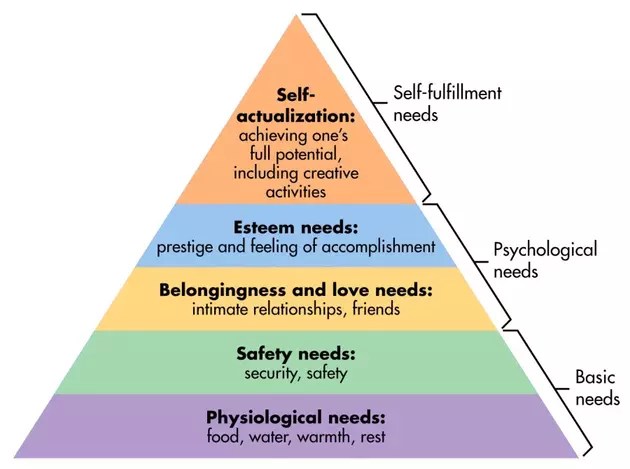
Needs Must – why paying attention to the hierarchy of needs is important in helping mental health service users to achieve their full potential

Most people are at least vaguely familiar with this diagram – Maslow’s Hierarchy of Needs. The theory being that we need the lower layers to be stable and consistent to build on the ones above.

My basic needs being met is something I’ve battled with consistently for at least the last half decade – in reality I’ve probably struggled to have my needs met for most of my life but because I had my basic needs covered – the rest of the pyramid appeared to be relatively stable, from the outside at least.

For the past couple of years I’ve struggled getting the lower 4 sections of my needs met. I can function to some extent if my basic needs are met – even if some of the higher ones, particularly psychological needs, are not met. However when those basic needs that everyone take for granted start to slide, things unravel pretty fast.

I’m at another point in my life where yet again my base layer of needs – Physiological needs – are not being met. And not surprisingly everything has fallen down around me. I’ve worked hard over the years to build the upper layers for myself – building friendships, working, doing things that bring me joy and boost my esteem – but the foundation layers have always been wobbly, so it doesn’t take much to bring them tumbling down.

Because I’m eloquent, generally fairly well dressed, have a job (even if I’m not working at the moment) and seem to have insight into my mental health problems, I often find that when people are taking my psychiatric history they skip out the more social aspects such as housing, safety and financial situation – all of which are major problems for me – but are presumed to be sorted because of the aforementioned eloquence. It’s the same equivalent as getting a really depressed person in and not asking them about elevated mood because they look so low right now. It’s really important to cover every area because you don’t know what might be lurking in people’s corners.

Currently, as a direct result of my mental health problems, I am not able to meet my basic physiological needs consistently – food (I can’t always afford it and I can’t heat things up myself so left without help I can only have cold food), shelter (I cannot access my house – even step beyond the threshold without support – renting a house is not the same as being able to access a house – and because my situation is so dire currently I don’t have any access to my house during the day times and don’t have access to my house 7 nights a week), warmth (comes along with the previous two – I’m stuck outside left to my own devices), rest (impossible when you don’t have somewhere to shelter and put your head down or even just chill out), water (I don’t have access to a toilet without walking at least 15 minutes (if places are open) or somewhere to wash except my cold outdoor tap).

Because my basic needs are not met, the next layer of needs – safety needs are difficult to meet. If I am unable to access my house, especially at night I am putting myself and my belongings at risk by sleeping rough, in my garden, being out and about at inappropriate times of night or being out and about in the day when its wet, or I am simply tired and don’t want to be out but have to be anyway. Add that to the fact that I’m in a significant mental health crisis right now – my security and safety are once again very compromised. Because of my PTSD I would not be able to protect myself from an intruder or attack as I go mute and freeze and/or dissociate very easily.

The next layer of needs are a complex one – the psychological needs. Some of these I am actually really good at doing myself (if the needs underneath are met adequately to support this). Belongingness and love needs – I make and sustain friendships very easily – however, at times when my other needs are not met – my friends are often relied upon by services to be my mental health carers and this is very damaging. However, because of untreated trauma, I have never (at the ripe age of 34) been in a romantic relationship. And I don’t think I ever will be able to unless I’m given the opportunity to address my trauma.

The next level, esteem needs is another complicated one. I have worked hard over the years to do things that increase my self-esteem as its naturally very low and because of being in repeated traumatic situations like this one it gets knocked down very easily. Prestige and a feeling of accomplishment is a very personal thing – sometimes I feel proud because I’ve slept rough and actually been independent for the night instead of having to rely on someone else – even if the experience was horrible. Other people might get a lot of feelings pf prestige over work promotions or buying a really fancy car, having children or owning a home. I get a lot of feelings of accomplishment through my skating and also through my work. But at the moment both of these thing are difficult to do because, quite frankly its impossible to turn up to the office and not be a total wreck when you’ve got the anxiety of a night with no shelter ahead of you. So once again this higher tier can’t be achieved unless the base layers underneath are adequate.

The top tier – self-actualisation, is something I definitely have not managed to achieve by any means in the lat decade. Achieving one’s full potential. I’m not denying that I haven’t made progress in some areas – less self-harm, more work and positive activities. But I’m hugely held back on this one because once again, nothing in the upper tiers is achievable if you don’t have the lower tiers nice and stable. I will never be able to move forward professionally – because I’m unreliable at work, because my basic and psychological needs aren’t met. I do have the potential, I know I do – I’m hard-working, fairly intelligent and good at making connections – but I will never be able to achieve my potential without the bottom 4 layers being dealt with.

I get a lot of people saying to me “oh but you have a job, you have so many friends, you have super fun hobbies – everything must be fine!” – but these mean very little, and in themselves are not achievable or sustainable if you don’t have a roof over your head and warm food in your belly. Everyone sympathises with the whole “moving house or separating is one of the most stressful things a human can do” thing – because in that process all our basic and psychological needs are jeopardised – even if that’s just for one day. Imagine if every day was as stressful as moving day, or the day you finally got a divorce. Thats what it is like for many of us with complex mental health problems who struggle to meet our basic needs every day. Whether that’s someone with memory issues who forgets to feed themselves or leaves the back door open by mistake. The person with depression who pushes away all their friends and family. The person with bi-polar who burns out because they haven’t slept for days on end. We’re all struggling to get those basic things seen to – so don’t be surprised when we can’t hold down a job, struggle to make friends or join a knitting group.

Work from the bottom upwards, slowly and steadily and you can help someone build a solid foundation upon which they can really achieve their full potential.

A Different Kind Of Crisis Care

April is a bit of a blur for me. I have not been well at all (and had been ignoring warning signs beforehand) but it finally got to the point where even I had to admit I was unwell. It was a bit of a perfect storm in terms of precipitating factors (which I don’t want to go into here but came from several areas of life and were largely out of my control), to be honest some of those things on their own would be enough to knock any bird off it’s perch – but a lot came at once and because I had been ignoring other warning signs beforehand (which was under my control but I’m having a hard time learning to cut myself slack and not try and paint a mask on) and it all kind of came to a head.

I carried on attempting to persevere – turning up to work, pretending things were OK etc. But by that point my body and my mind had already gone through the mill a bit and it wasn’t until I got to the point I was unable to remember being in various meetings at work, unable to travel from A to B independently, and even not be able to do the washing up, tolerate having my beloved ratty boys around me or remember to eat or drink, That I finally started listening to those around me and admitted I might need to take it easy for a while and look after my mental wellbeing. I am someone who lives with severe mental health problems every day but goes to great lengths to live a life of someone who doesn’t…and inevitably I can’t keep it up forever.

It’s been a long, hard slog – and one that felt like it was only going from bad to worse for a good few weeks. But I’m finally starting to piece myself back together – but tentatively. This has been a period of significant crisis – of which I probably haven’t had now for about 6 months since my life became a lot more stable and manageable. However, for the first time, we navigated through this crisis using the resources that were already available to me – but just more flexibly. I did not need intervention from the crisis team or home treatment, nor did I need to spend the night in the decisions unit, crisis house or a ward – and this is new to me but so much better. Yes, I did need medical attention on several occasions and the emergency services were also involved several times but these were all well dealt with and swiftly able to be handed over back to my normal care.

As well as being mentally unwell I have also struggled with the after effects of several head injuries which has resulted in an elongated period of concussion making me physically less able, struggling with memory, processing and managing tasks etc. This has been something I’ve found particularly difficult as I couldn’t do the things that help myself. Hats off to those that live and manage life with a more serious long-term brain injury. It really is hard.

So what helped manage this crisis period? I have several things at my disposal now that I have not always had in the past – or have had these things limited and therefore my ability to utilise them wasn’t great.

A safe place: This is the first time in a number of years that I’ve gone into a crisis and had a safe place in which to attempt to heal myself. A stable, accessible and safe home has not been a given for me until very recently. In the past year I’ve had the physical safe place but not always the means to access it. This time, I was able to use my support hours flexibly so my awesome team of Personal Assistants (PAs) could help me stay at home as much as I needed. This is so basic and something a lot of other people don’t even think about but for me has been something I’ve never had. It’s the absolute baseline of maslow’s hierarchy of needs and without this there is little point trying anything else. It makes me cringe when I’ve been in crisis previously and been sent back out into the cold with no safe place to be – told to “use my coping skills” and maybe offered a follow up phone call – how could anyone ever think I could successfully pull through a crisis without that? I spent years beating myself up because I couldn’t – but now I’m starting to realise that wasn’t OK and no one should have expected I could make it safely through crisis without a safe home.

Personal Assistants: OK so I know this definitely is something I am fortunate to have – but I only have them because basics like accessing home, cooking warm food and feeling safe are not possible for me without assistance. My PAs have been in place in some format for over a year now but this is the first time they’ve been allowed to help me as they see fit – previously they were under very tight restrictions as to how many hours they could work and were not guided by the mental health team or each other. Now they are well supported with external supervision, by each other and by my care co-ordinator if necessary – they are able to appropriately help me have access to the tools and resources so I can get myself back on track. In this time of difficulty they took more charge than they usually would on my daily life – making decisions about whether or not I had day shifts, cooking for me and making sure the ratty boys were looked after – all things that functioning Ellie can usually manage. This allowed me to free up spoons to help me just get through the day safely.

Mental Health team supporting flexibly: Particularly in the last year I have been actively told to not reach out for help from services (and indeed I stopped doing that even if it put my life at risk) and even been bullied and blamed for not managing in adverse situations. However, 6 months ago things changed and I got a new care co-ordinator and additional support from a senior member of staff. This also coincided with input from an OT from a charitable organisation to help with my eating disorder. With these people in place I have rarely had to ask for help – because it’s there if I need it. They all responded in a compassionate, non-judgemental and non-punitive way. I wasn’t made to feel like I was a crap human being, or guilty for how I was struggling. They discussed risk and self harm openly with me – wanted to find out more about how this was for me, and most importantly did not make me feel like I’d failed when risk did occur. I had phonecalls or appointments a couple of times a week that I didn’t have to beg for or explain myself to someone who had never met me before. Just a gentle catch up and helping me break my day down into small, manageable chunks. I was assured they were there, and to please ask for help if I need it. The OT even was able to come round and help me process my PA’s timesheets which were due and very complicated to do and something I just couldn’t fathom managing (which further freaked me out because I was worried my PAs wouldn’t get paid for their hard work). With this gentle, flexible, empowering support I did not need the input of any additional crisis services, and it has tailed off gently as I now don’t need it as much – this is different from the very sudden ending when working with Home Treatment for example.

Supportive workplace: I am incredibly fortunate that my management are more on the ball about my mental state than I am – encouraging me to take things easy and supporting time off before I would let myself do those things! They have been unconditionally supportive, kept in touch and allowed me to take control of phasing back into work in the best way for me. In addition, I did something I have never previously done and put an out of office reply on – specifically stating that I was taking time out to look after my mental health. I was incredibly anxious about doing this but the response has been people knowing that I’m not working at 100% ability, and other colleagues being incredibly supportive and welcoming on my return. Knowing that my livelihood will be there for me when I’m better helps me pull through much faster I feel.

Friends and family: I struggle in asking for help from anyone full stop, not just services. So reaching out to my social networks is difficult. However I have some amazing people in my life who are sometimes quite proactive and forwards with their support. Which I’m very grateful for as I’m often unable to ask or articulate that I need help. On more than one occasion I’ve had friends turn up because they suspected I needed help and was unable to call for it. I’m so fortunate to have these people in my life – and the others that just send gentle end encouraging messages or little gifts through my letter box. It all helps and it all means so much.

Going back to basics: Especially because I had a head injury as well as my “normal” non functioning, I really needed to strip life and the tasks I had to complete right back down to basics. This involved things like batch cooking so I could have the same lunch every day – taking off the decisions and food preparation so that I could concentrate on eating it. It meant literally only thinking about hour or even minutes ahead. It meant saying to people “I’m sorry I can’t do this for you right now, I just need to take time to concentrate on my mental health”…something I find incredibly hard to do but was important that I did.

Doing what I feel my body and mind needs without judging: I often don’t do the things that I know inside I need to do – because I place a lot of judgement on myself or worry about judgement from others. But I’ve really tried to listen to my body, my mind – their most basic internal needs and go with them. Yes that means I haven’t left the house without at least 3 cuddly toys in my bag and wearing noise-cancelling headphones in about 4 weeks. But it’s what I need to make the world less overwhelming and allow the smaller parts of me to feel comforted and safe. I even turned round and apologised to my colleagues last week because I’d just had several back to back meetings and I needed to curl up under my desk with my cuddly toys and grounding playlist. They didn’t bat an eyelid because they knew that by doing that I was assuring I could make it through the work day.

I’m still a long way from “optimum Ellie”, this has been a significantly difficult period and the precipitating factors are not resolved nor have they gone away. But I’m getting there and slowly learning to make the right choices – even if I’m embarrassed about them or worried about judgement.

I had a beautiful interaction with a consultant in A&E last week who had known me when I was a “revolving door” case several years ago. She reminded me how broken and hopeless I was back then, and although she could see I was going through a difficult period, she was amazed at the way I was managing things compared to back then. It felt good to tell her I was working and rarely came to A&E anymore. She told me that she was now the mental health lead for medics in the department and that it was people like me that had inspired her to keep combatting the stigma surrounding people like me in the department. That felt good.

I’ll get there. But bear with me for a little while whilst I work on myself for a while.

Caution: Do Not Open This Attachment

Attachment is a bit of a touchy subject for anyone with a BPD label. Whether or not we have attachment issues stemming from childhood, we will probably develop an unhealthy attitude towards attachment during our so called “BPD recovery journey”. This looks different for different people. I have friends that will openly admit and claim attachment to just about anything – including professionals. I know others who have been let down and hurt so many times in their lives that they won’t let themselves form any attachments to anyone, or anything. Then there are others, like me, who are so scared of being labelled as “attached” or “dependent” and the connotations that brings with it within services that they will go to great lengths to force themselves not to feel any attachment to any aspect of their care or interactions with services, or if they do – they won’t admit it.

I’m used to comings and goings. I’m well rehearsed at goodbyes. I’ve lead quite a transient life for the past two decades, across more than one continent. I grew into an adult in the Middle East – where the countries of the Arabian Gulf have a constant ebb and flow of international expats. I’ve been to uni, I’ve travelled, I’ve been in many different jobs, friendship groups and lived in different places. I’ve been in and out of units, hospitals and day programmes – each time with a different population, even if it is the same place. I’ve had more than 8 care co-ordinators in half as many years. I’m used to moving on, I do it well even though I struggle with changes. Everything comes to an end at some point and I accept that and am OK with it.

I’ve also had plenty of constants in my life. My parents live in the same house I grew up in, I still live in the city I was born in (albeit a very different Sheffield!). I have friends who I have known for years. I don’t think I have unhealthy attachments.

So why am I so paranoid at this label? This judgement that just one part of my life puts upon me? In services, showing signs of attachment is bad. But in the rest of my life I am praised for my ability to make appropriate connections and maintain them (though it doesn’t come easily – I have to work hard at this). Even in my work – in the same organisation I receive care from – I am praised for networking, building connections and nurturing them. Log onto supervision records and I’m someone who works well with others. Log into the patient records system and it is a very different story. Suddenly I’m this clinging gremlin who needs to be shook off. Overly dependent. Must be cut off. Must not do anything to build up too much of a rapport because the dreaded “attachment” might occur.

So I don’t let myself do it. I presume I should not show any emotion or feeling when things suddenly chop and change. I wait on edge – preparing myself for when it is pulled away. If someone asks me how I feel about it I will automatically say “I’m fine, it doesn’t bother me”. I am a robot. Robots don’t have personalities. So their personalities can’t get disordered. Robots are not sentient beings, they don’t need anyone else, they don’t need attachments. I have to prove I have no attachment to any aspect of services. Because that is what people want of us. I had one clinician last year tell me “Oh I never tell “PD patients” if I’m leaving because it just causes me problems before I go.” Incredibly sorry for your inconvenience – we’re just trying to navigate this minefield!

I am the same person who goes to work, as I am the one who walks into an appointment. But suddenly what is good becomes bad and what is bad becomes good. Right becomes wrong and wrong becomes right. How am I supposed to know what is right in the world? Yes, maybe some of us do have difficulties knowing how to form appropriate attachments – but put yourself in the shoes of someone who is constantly being given conflicting messages about what is “healthy”. Is the behaviour you’re “observing” the result of a personality defect or is it simply because the person is confused and doesn’t want to get hurt and either clings or pushes away in a desperate act of self-preservation.

I hear many clinicians say “Oh its so hard to work with BPD patients, because we don’t want to run the risk of forming attachments” Replace the word “attachments” with “a healthy, trusting, reliable and working relationship” and suddenly that sentence sounds completely bizarre doesn’t it? By running the risk of creating an “attachment” you are also running the risk of providing a safe space for someone to explore themselves, nurture and grow – and ultimately fly the nest when they are ready. Because that’s how a healthy attachment starts and ends – naturally.

You are a human being. The best way to care for someone is to use your skills as a human being and not go against them.

Sharing the story

So the title of this post is probably a bit misleading – I’m not going to be sharing the whole of my story – for starters you would need 31 years and 51 weeks to understand it fully and I also don’t want to be that person who walks into a party and starts up a conversation going into mega detail about the pain in their leg they’ve been having for a couple of weeks. I’ve had a pain in my head for pretty much a whole lifetime but it’s not the only aspect of me – so this blog will talk about other life experiences as well as those related to my mental health. I am lucky to have had a very varied and wide range of experiences in my life – some hilarious, some traumatic, some close to home, some thousands of miles away- and they all shape who I am today. But I’m more going to be talking about the process behind sharing my story.

I’ve often been told “you should write a book” “you should write a blog” and everything in between. To put it quite bluntly I’m too busy doing life to sit down and write a book but if someone comes up with a technology where you can just scan your memories into a computer and it’ll write a book for you I’d happily comply. But a blog seems a reasonable compromise. And I’m not sure what it’s purpose is but the more I am learning to share my experiences (and it is literally my job now to do so) the more I’m realising that my story is potentially an important one to tell. I come across a lot of people who “don’t expect those sorts of things to happen to someone like you” or who say “I would never have known you go through all that – you look so normal” (if anyone would like to draw me a picture of what “normal” looks like please feel free to send me mail!) I think what they mean is that I don’t shuffle around muttering to myself, I am capable of eloquent conversation (most of the time), I have done a lot of things in my life, I am willing to engage with treatment (that has not always been the case), I do have have job, I do have hobbies and interests and I’m not locked up in a padded cell – on a good day – apart from some visible scarring, I can show no outward signs of mental illness. Yet every minute of every day I’m battling barriers that would make most people curl up in a ball and never leave their beds. “But it’s ok for you – you’re determined and motivated and strong”or “I couldn’t do what you do – I don’t know how you do it” … kind words and I understand the sentiment – but I think sometimes people think I have some superhuman powers of coping that other people don’t have. That, to be totally blunt, totally belittles the effort I have to put in to keep myself going every day. I’m not special at all and I wake up every single morning, slightly dissociated and confused and when I ground myself I want to die. Because that’s how I’ve always known waking up to feel like…wanting to die. Exhaustion at the idea that I’ve got to battle through yet another day. But the difference now compared to a few years ago is that (usually – and this does wibble slightly) within a couple of minutes I remember the novelty that I do have a life, I do have plans, I do have a job to go for, I do have friends and happiness does exist. So I haul myself out of bed and face that day because positive memories can’t be made lying in bed.

It is possible to live with severe mental illness and lead a fulfilling life – yes it might be rather more complicated, frustrating, less in your control and certainly more effort than your average person “doing life stuff”. But it is possible. I have the odd situation of being a service user (and one of those irritating ones that gets labelled as “complex case” (I’ll talk about my feelings about that in another blog) and is quite stuck in the system) and an employee in the same mental health trust. I am also someone who needs to be in a pretty significant level of 24/7 support but I can also hold down a job. My disability doesn’t define my ability and my ability doesn’t define my disability. People get very narrow minded that because I can work and travel across the world and put my pants on the right way round (though FYI last Wednesday this wasn’t the case) that therefore I must be able to cope with everything else and I spent years trying to get services to understand this. I’m all for a positive spin on things but solely concentrating on the fact that I’ve got a really good set of hobbies and friends and totally ignoring the fact that I’m incapable of entering and moving around a building independently or making a hot meal for myself or sometimes getting myself to the corner shop – isn’t going to help me move forwards in life. It has taken me a long time to accept that “both can be true” (a good old’ DBT dialectic) but I still think a lot of professionals have a long way to come to truly understand that this can be the case for a lot of people.

Hence why it’s important to talk. It took me YEARS to learn to talk. Diagnosed in 2005 with an eating disorder I took years to actually admit to anyone there was a problem (despite not doing well at my A- levels, having to take two gap years and being chucked out of uni and a job because of my illness) – I was an expert in denial and “yeah but” was my favourite response to challenges. I think in 2012 I started to realise maybe something was wrong (by this point I was in day treatment for eating disorders but couldn’t shake off the feeling of being a fraud so wouldn’t really open up to anyone) and then after a pretty disastrous 2013 I finally accepted something wasn’t right and would start to open up in private sessions with professionals. At some point at the tail end of 2014 I made a decision to start to stop hiding my mental illness (by this point I had been in day treatment for eating disorders 3 times, was in an acute psychiatric ward and had been hospitalised several times for overdoses). Prior to this I had always covered my tracks with most people except those that really needed to know. I started to let people know and far from being rejected by all and sundry I found that the response was surprisingly positive. I continued to struggle with actually opening up about what was going on for me but I did speak out arbitrarily about mental illness and didn’t hide that I suffered but it wasn’t until I was admitted to a year long specialist admission in York that I actually learnt to talk about what was happening. And that was a huge turning point. It didn’t miraculously make me recover or improve services but it did help me start to unpick and understand what on earth was going on in that grey matter of mine – and although I am still in a very complex point in my life – this ability to speak and articulate more about what is going on is going to eventually get me closer to where I need to be.

I’m also fortunate enough to have a job role where I don’t have to hide my mental illness…in fact so far from the truth because having experience of mental illness is in the job description for my role. And that’s a complicated dynamic – and one that takes practice and I’m still learning to perfect. But how honoured am I to have the opportunity to be in a position where sharing my experiences can genuinely influence others – people recovering themselves, professionals and how they practice, and maybe…just maybe…even have some influence on how services are run. Speaking out is the most important and scary step I’ve ever taken, but it’s worth it – for myself and for other people.